The Other Way Around
by Philip Dutton
Phillip is one of the founders and coalition leads for the James Taylor Justice Coalition in Kent County, MD.
In the spring of 2019, a friend gave me a magazine article about Bryan Stevenson, the founder of the Equal Justice Initiative (EJI). I had read Mr. Stevenson’s book, Just Mercy, and watched the movie based upon the book, so I was aware of EJI’s work on criminal justice reform. I did not know about EJI’s racial justice work, the Legacy Museum or the National Memorial for Peace and Justice. It became clear to me during the Presidential campaign of 2016 that racism is alive and well in the U.S. Having grown up in a small North Louisiana town in the 50’s and 60’s, I was indoctrinated into racism. Though not as obvious, there is still racism in Chestertown, MD where I now live. Although I had enjoyed white (and male) privilege my entire life, I never analyzed how I had personally benefited. I committed to learning more about white supremacy and white privilege. I started reading books: Between the World and Me – Ta-Nehisi Coates; The Color of Money – Mehrsa Baradaran, The Hidden Roots of White Supremacy – Robert P. Jones, and many others. I was able to join a 9-month seminar series on racism and white supremacy.
As it so happened, my wife and I were planning a driving trip to New Orleans in April of 2019. We took the opportunity to spend two nights in Montgomery and visit EJI’s Legacy Museum and the National Memorial for Peace and Justice. On that first trip to the Memorial, I found James Taylor’s name on the Maryland hanging steel beam. Little did I know, but James Taylor would become a focus of my life for the next seven years.
Not long after we returned from New Orleans, I learned that there had been a lynching in Wilmington, DE and that a soil collection and historical marker dedication were planned for June 23rd. The primary driver behind this effort was a16-year-old high school student, Savannah Shepherd. She was scheduled to speak at the library in Townsend, DE the next week, so I drove up. That night I met Savannah and her mother. Impressed and intrigued, I subsequently attended the George White (lynched June 23, 1903) soil collection and marker dedication that June. Senator Chris Coons and many other dignitaries were in attendance. I thought, “If a 16-year-old high school student can do this in 14 months, we should be able to get a marker for James Taylor (lynched May 17, 1892 in Chestertown, Kent County, MD) without too much trouble.” HA!
Savannah and her family had attended the grand opening of the Legacy Museum and National Memorial for Peace and Justice in Montgomery in April of 2018. It was that experience that changed Savannah’s life. She met Congressman John Lewis there. She also met Bernice King, Martin Luther King, Jr’s daughter, and Claudette Colvin, Montgomery Bus Boycott pioneer. Savannah was inspired and became passionate about social equity and justice. She founded the Delaware Social Justice Remembrance Coalition and devoted her considerable talent and boundless energy to the George White historical marker project. Read about Savannah’s accomplishment HERE.
With the support of Sumner Hall, Board President Larry Wilson and I, along with a small group of volunteers, created the James Taylor Justice Coalition (JTJC) in 2019. As we began to recruit individuals and organizations to join our coalition we encountered some push back. Kent County, it seems, is very different from Wilmington. There were two primary concerns: 1) why erect a marker to such a horrific event that is traumatic for many in the African American community? and 2) fear that the racial balance in rural and mostly segregated Kent County would be risked, i.e. the sleeping dogs would be awakened.
We turned to EJI for guidance and resources. We also reached out to Will Schwarz at the Maryland Lynching Memorial Project for support. Rather than pushing ahead with a soil collection and historical marker effort right away, the JTJC undertook a community education campaign. A Justice Day was planned. The keynote speaker for that first Justice Day was Savannah Shepherd. We hosted book readings. The first was Sherrilyn Ifill’s On the Courthouse Lawn. Ms. Ifill called-in to participate in that discussion.
The COVID pandemic interrupted our progress. In the meantime, we decided to plan a soil collection ceremony for May 2022. We felt that our community was ready for a soil collection, but there was still some resistance to a permanent marker. In conjunction with the soil collection, the JTJC partnered with Minary’s Dream Alliance to plan a civil rights bus trip to Alabama and Georgia. In addition to going to civil rights sites in Birmingham, Selma, Montgomery and Atlanta, the 56 youth and adults on the bus would deliver the James Taylor soil collection to the Legacy Museum. The documentary film, Get on the Bus, was made about the trip.
Even after all this, it took the JTJC another four years to erect an EJI Historical Marker for James Taylor. Getting a location on public property was challenging. Not necessarily surprising, there was resistance to putting the marker on the courthouse lawn even though the county jail where Mr. Taylor was held in 1892 was adjacent to the courthouse. There was objection to locating the marker on the corner of Fountain Park in Chestertown. Mr. Taylor’s body was held at that location until he was buried in the Almshouse graveyard. Finally, in 2025 the Chestertown Town Council approved the placement of the marker near the location of the actual lynching tree. Negotiating the language on the marker with EJI took several more months.
On May 17, 2026, exactly 134 years from the day when James Taylor was lynched in Chestertown, his marker was dedicated. Before a standing room only audience at Emmanuel Episcopal Church, speakers delivered powerful, emotional and inspiring words, including an official apology from the Town of Chestertown. And in the audience were Savannah Shepherd and her mother, Amy. Having graduated from Swarthmore College, Savannah is now working as a legal assistant for a national law firm in Washington, DC that specializes in human rights law. Soon she will begin law school in California. Savannah’s passion for social equity and justice continues.
One typically thinks of young people being inspired by older individuals: coaches, teachers, authors, grandparents, or colleagues. In our case, it was the other way around. At the young age of 16, Savannah inspired me to make a commitment to erecting a marker for James Taylor in Chestertown. I am grateful to her and excited for her future. Thank you, Savannah.
Baltimore County Lynching Memorial Project Takes Action to Halt Red Maple Place
The following statement was released by the Baltimore County Lynching Memorial Project in response to potential violations of federal civil rights and environmental laws, including Title VI of the Civil Rights Act of 1964, the Fair Housing Act, and environmental review requirements applicable to publicly supported development projects.
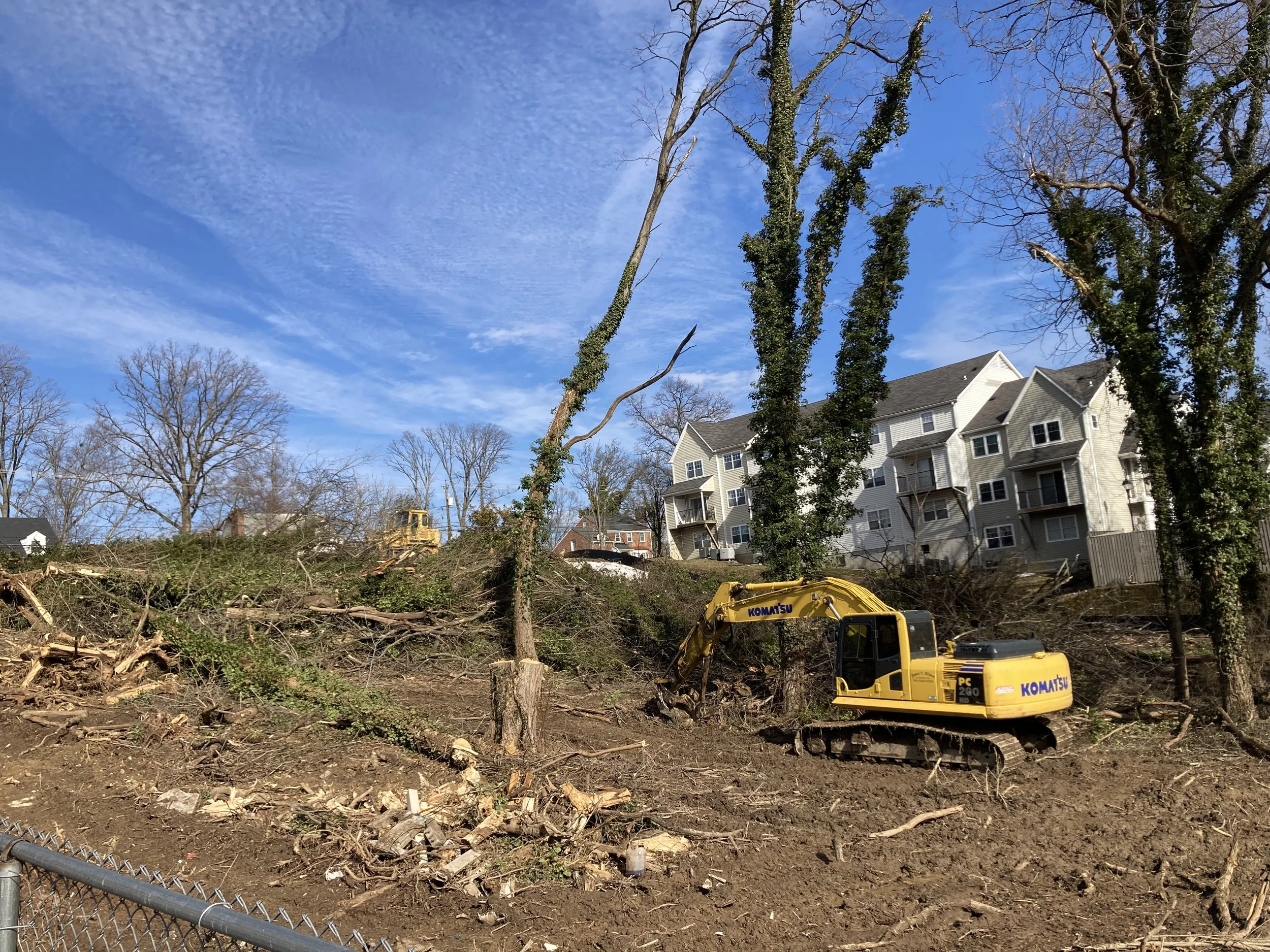
Recently cleared site in Historic East Towson. Image provided by BaltCoLMP.
The Baltimore County Lynching Memorial Project (BaltCoLMP) today announced that it is calling for actions to halt the proposed development known as Red Maple Place on land in Historic East Towson.
BaltCoLMP is exploring all available remedies, including requests for regulatory enforcement, to immediately stop ongoing construction activity and prevent further irreparable harm while federal, state, and local compliance issues are reviewed. BaltCoLMP is also evaluating potential violations of federal civil rights and environmental laws, including Title VI of the Civil Rights Act of 1964, the Fair Housing Act, and environmental review requirements applicable to publicly supported development projects.
Portions of the wooded area at the proposed Red Maple Place property in Towson have already been cleared by contractors, including 75 of the 100 feet required as forest buffer protecting on-site wetlands. Baltimore County regulators granted a variance that reduced the requirement significantly, from 75 feet to only 25 feet. These activities raise serious concerns regarding compliance with environmental permitting requirements, infrastructure adequacy standards, and procedural safeguards intended to protect both natural resources and affected communities. Baltimore County’s own records document the lack of adequate sanitary sewer capacity to support the proposed development, further underscoring the need for immediate intervention.
Historic East Towson is one of the oldest remaining African American communities in Baltimore County; established by formerly enslaved individuals connected to the Ridgely estate (now known as Hampton National Historic Site), it is still home to their descendants. For generations, this community has endured cumulative land loss, infrastructure intrusion, and development pressures that have reduced green space and fragmented neighborhood cohesion. Government-supported actions that impose additional environmental and other burdens on a historic Black community raise serious civil rights concerns, including potential disparate impact and environmental justice violations under federal law.
Community members, environmental organizations, preservation advocates, and civil rights leaders have repeatedly raised questions about whether the Red Maple Place project satisfies state and local standards of environmental sustainability, smart growth, and equitable planning. Where public funding, approvals, or infrastructure support are involved, federal law requires decision-makers to evaluate environmental impacts, consider reasonable alternatives, and ensure that actions do not result in discriminatory effects on protected populations. These safeguards exist precisely to prevent the type of cumulative harm now at issue.
Long-time allies and supporters of Historic East Towson have been invited to join forces with us to oppose the project and to protect the community from further harm. State and local elected officials who have expressed concerns about the proposal have been outspoken in their opposition and are already taking action through legislative, regulatory, and advocacy channels.
BaltCoLMP asserts that continued construction activity risks causing irreparable environmental damage, undermining community integrity, and violating procedural and substantive protections
guaranteed under civil rights and environmental statutes. Immediate intervention is therefore necessary to preserve the status quo while legal and regulatory review proceeds.
Accordingly, the Baltimore County Lynching Memorial Project is demanding:
Immediate issuance of a Stop Work Order (SWO) and cessation of all site activity
Preservation and stabilization of remaining forested and wetland areas
Independent environmental review, including analysis of alternatives consistent with federal environmental review standards
Full disclosure of infrastructure capacity analyses, including sanitary sewer adequacy
Transparent accounting of public funding sources and associated civil rights compliance obligations
Meaningful consultation with Historic East Towson residents regarding lawful and equitable alternatives
BaltCoLMP is committed to the rights and history of Historic East Towson. Environmental justice and civil rights compliance are not optional considerations. They are legal obligations.

Lynching is not a Relic of the Jim Crow Past. It's a Modern Form of Racial Terror.
by Terry Anne Scott, PhD
Terry Anne Scott, PhD is the Director of the Institute for Common Power and serves on the MLMP Board
The following article was first published in 2020. Terry Anne Scott, PhD stated: "It rings true today and places the recent alleged lynching of a young Black in Mississippi in a broader context." It has been reprinted with permission.
The moment haunts me. It resides in my consciousness as a harbinger of stalled progress. It grasps my existence with the tension of every maddening expression of racial othering and inhumanity I have witnessed, studied, experienced.
It was the moment when I saw the slender, round face of a young Black man, gleaming with the innocence of an unsuspecting altruist — the moment I read his last words, filled with the clemency seemingly reserved for an ethereal being. “You are all phenomenal. You are beautiful and I love you,” he averred to police officers as they wrestled him to the ground before he died. It was the moment I realized that Elijah McClain was lynched. I fell back into my chair, crestfallen.
As a professor of African American history and scholar of lynching during the late 19th and early 20th centuries, I teach this as a part of the nation’s sordid past, including the destabilizing impact it has on the African American community. In recent years, I had largely shied away from making such historical comparisons out of respect for the unique circumstances that helped define and contribute to the countless lynchings that swept the United States throughout the first half of the 20th century. In recent weeks, however, the comparison has become more prescient as the world has seemingly collapsed onto its own wretched history.
The last few months have allowed us all to bear witness to a disturbing and unavoidable reality: Lynching is not a relic of a Jim Crow past; it is in fact a modern form of racial terror. The spectacular brutality once preserved and disseminated through photography and corporeal souvenirs is now captured by cell phones and body cameras, allowing society to witness racial terror in all of its modern forms. The recent asphyxiating tide of murders — the aural and visual replaying of death — has left us all gasping for breath. Still writhing from the suffocating reality of Ahmaud Arbery’s murder in Georgia, we were forced to confront the indescribable pain of witnessing George Floyd’s murder in Minnesota. And yet the term “murder” somehow fails to convey the extraordinary cruelty of their killings. Elijah McClain, Ahmaud Arbery and George Floyd were all lynched.
Each case presents a set of facts comparable to the history of lynching in the U.S. as defined by the Tuskegee Institute: a killing that occurs without due process, committed by “three or more persons, done under the pretext of service to justice, race, or tradition.” Lynching victims in the first decades following the Civil War were often white. Their alleged crimes typically involved horse theft, cattle theft or murder. Furthermore, their bodies were frequently found hanging from trees in the hours or days following their deaths, and the parties that lynched them, if seen, were often masked. By stark contrast, after Reconstruction, the lynching of Black bodies was done with a visibility, impunity and fanfare that would come to define a new lynching narrative.
Once a strictly punitive and largely clandestine form of extra-legal punishment, lynching evolved into a wholly racialized, publicly viewed, well-attended, frequently commercialized exhibition of mob violence. The lynching victim was now typically Black, and a mob’s fear of judicial retribution for its murderous efforts nearly disappeared. In the process, the concept of crime shifted. This new lynching narrative punished the crime of Black existence rather than a specific criminal act. Black lives, it said, did not matter.
We tend to think about what defines crime in conventional ways, with a consensus understanding of what constitutes crime (arson, murder, etc.); but the definition of crime changes when race and a racial hierarchy are involved. During the postbellum era, in the absence of a master-slave dyad when whites sought to reinforce white supremacy, a crime committed by a Black person was perceived as particularly egregious misconduct that often signaled a broad call to action. Such incidents not only encouraged but ostensibly required a suspension of due process in an effort to maintain white supremacy.
The list of offenses allegedly committed by African Americans that forced the assemblage of a mob predictably involved crimes against the white body, including murder, rape and assault, even when evidence to support the allegations was thin or non-existent. Dubious allegations, however — such as flippantly responding to a white man, voting, writing a letter to a white woman, suing a white person and being too prosperous for a Black person — were also counted as impudence punishable by mob violence. This gamut of transgressions, wavering between modern interpretations of criminal transgressions and the fiercely ridiculous, exposes the mutability of crime. The idea of what constituted a crime had clearly become something subject to unbelievably racist and horrific interpretations.
When a local sheriff found Ben Little, an African American man arrested in Mount Pleasant, Texas, in October 1885, dead and hanging from a tree after a mob removed him from his cell, a note pinned to Little’s back featured the following message:
This negro was not hanged for the highway robbery he committed in Titus County last Wednesday, but for the slanderous talk he has had about a certain white family in Mount Pleasant, which we deem a scandal to the white race. The family is as innocent and pure as the angels in heaven, and we feel that we have not committed a sin in the sight of God, and furthermore, we feel that we have done a great and noble act for our country as gentlemen. Speak to the dead for further information.
The note was signed “CITIZENS OF MOUNT PLEASANT TO THE NUMBER OF SIXTY-EIGHT.”
The white patrolling of Black people’s “place” has too often served as the superlative entity in an algorithm for what renders a crime a crime; expressions of freedom, sovereignty and advancement by Black people continue to function as crime in the same manner as violent misconduct. What appear as seemingly benign activities continue to gain potency when the perceived aggressor is Black and the racial hierarchy is ostensibly threatened.
Over the last few years, we have seen increasingly that freedom expressions of Black people are still criminalized. White citizens who believe they are patrolling their local environments are in fact patrolling racial boundaries. They have in recent months called the police on Black people who are, for instance, giving a dog a treat, hosting a lemonade stand, having a barbeque, attempting to use the gym in their own residential building, picking up trash in their front yard or simply jogging. Crime, then, is still something defined by historically specific phenomena, by the nuances of an everyday existence, by social interactions, and ideas about race and identity, by sheer racism. At times, the outcome is death.
McClain was returning from the store in Aurora, Colorado, after purchasing iced tea for his brother. Donning a ski mask — a choice his sister said he often made because “he had anemia and would sometimes get cold” — McClain was approached by several police officers who ordered him to stop. The person who called the police reported that McClain seemed suspicious. Officers placed McClain in a carotid hold. “I can’t breathe. I have my ID right here. My name is Elijah McClain. That’s my house. I was just going home,” McClain exclaimed in vain. First responders administered an injection of ketamine to McClain in an alleged effort to sedate him. McClain suffered a heart attack en route to the hospital and passed away days later on August 30, 2019.
The outcomes for Arbery and Floyd were similar. When Gregory McDaniel contacted 911 after seeing Arbery, the operator inquired of McDaniel the nature of the crime being committed. He replied in part, “There’s a black male running down the street.” We can imagine that in the minds of the men who killed Arbery, he was not a young man innocently jogging down a neighborhood street on a sunny day. He was the conflation of Blackness and criminality that has pervaded an American consciousness and has been produced and reproduced across time and space. Two months following the death of Arbery, four officers apprehended and killed Floyd for allegedly attempting to use a counterfeit $20 bill to purchase cigarettes. Each death points to a seemingly undeniably conclusion: The extraordinary violence exacted upon McClain, Arbery and Floyd was done so to punish the criminal act of Black existence, to demonstrate the triumph of white over black.
During the heyday of lynching, local citizens and law enforcement agents could (and did) act without — although at times with — sanction from the court and public administrators because they assumed their ultimate authority to be judge, juror and executioner of last resort. Lynchers settled into a knowledge, a comfort that their actions would not be disrupted, and they would not be prosecuted. In 1916, after the lynching of Jesse Washington in Waco, Texas, NAACP investigator Elisabeth Freeman asked Sheriff S. S. Fleming why the 50 deputies he had recently sworn in were not present to shield Washington from the crowd that removed him from the courthouse and burned him on the lawn of City Hall. Fleming rhetorically responded, “Would you want to protect the nigger?” The men who killed McClain, Arbery and Floyd similarly acted as judge, jury and executioners. None of the three victims were afforded due process nor the opportunity to demonstrate their innocence, and each of the killers seemed confident that they would not be prosecuted for their actions.
Indeed, the police killings of Floyd and McClain sit squarely on a historical continuum of lynchings committed by police officers, a reality that runs counter to many people’s notion that lynchers often acted in opposition to law enforcement. In 1892, 18-year-old William Sullivan was hanged by a mob, led by Deputy Sheriff James Augus, in Plantersville, Texas, after Sullivan claimed that a white woman was his wife. Augus chained Sullivan to a ceiling column then traveled around the area inviting local residents to witness Sullivan’s death: “This young nigger is smart and talks back to white people, and now is a good chance to remove him,” he shouted.
The state failed, in the killings of McClain, Arbery and Floyd, to exact justice initially or at all, and instead validated racial vigilantism as a viable form of justice. Mike Freeman, the county attorney for Hennepin County who first investigated the death of Floyd, said during a press conference that his job “is to prove that [officer Derek Chauvin] violated criminal statute — but there is other evidence that doesn’t support a criminal charge.” Similarly, when Travis McMichael, Gregory McMichael and William Bryan murdered Arbery on February 23, 2020, after they saw him jogging down the street, District Attorney George E. Barnhill, who early on investigated the case, penned a letter that sought to exonerate Arbery’s murderers. “It is my professional belief the autopsy confirms what we had already viewed as shown in the videotape, with the photographs and from the witness statements taken immediately at the scene,” Barnhill stated, insisting that, “we do not see grounds for an arrest of any of the three parties.” He added that they were in “hot pursuit” of a criminal due to the baseless claim that break-ins had recently occurred in the neighborhood. Charges were eventually brought against those involved in the deaths of Arbery and Floyd. As of today, however, no charges have been filed in the death of McClain.
An autopsy conducted by the Adams County coroner declared that the cause of McClain’s death was inconclusive. His death, the coroner argued, could have been caused by the carotid hold or natural causes. As a result, District Attorney Dave Young cleared the officers involved in McClain’s death of any wrongdoing. “The forensic evidence revealed that the cause of death was undetermined,” Young argued. “Specifically, the pathologist who conducted the autopsy stated that he was unable to conclude that the actions of any law enforcement officer caused Mr. McClain’s death…. Based on the facts and evidence of this investigation I cannot prove beyond a reasonable doubt that the officers involved in this incident were not justified in their actions.”
In the cases of Arbery and Floyd, the initial, state-sanctioned autopsies similarly failed to provide clear culpability for the men who murdered them. This conclusion is reminiscent of lynchings from the past when coroners’ reports worked to absolve lynchers of any wrongdoing.
In 1895, T.D. Hightower, acting coroner at the time of Nelson Calhoun’s lynching, exonerated the individuals responsible for the murder by publicly stating that Calhoun died “in the hands of parties unknown to me,” despite the fact that the lynching was committed by unmasked individuals. Hightower added that the death was “deserved.”
After completing a formal inquest into John Henderson’s mob death by burning in 1901, Justice of the Peace and Coroner H.G. Roberts, sworn to uphold the majesty of the law, drafted his ruling: “I find that the deceased came to his death at the hands of the incensed and outraged feelings of the best people in the United States, the citizens of Navarro and adjoining counties…. His death was fully merited and commendable.”
Over the course of the last several months, the bodies of at three men and one transgender woman — all African American — have been found hanging from trees in public spaces in four states. Local citizens have called into the question the veracity of official claims that the deaths were suicides, due largely to evidence that suggests medical examiners and law enforcement rushed to judgement.
Such rulings were not unusual during the mid-20th century when the hangings of dozens of Black men were ruled suicides, claims that frequently sought to absolve local authorities from further investigating what was likely a lynching. The claims also revealed the dismissive value of Black lives.
We have witnessed the passage of civil rights legislation, the election of a Black president, the slow establishment of new social and moral paradigms that have rendered such things as murdering a person for attempting to vote a relic of an iniquitous past. None of these has resulted in systemic change to prevent the type of violence and brutality that attended the murders of McClain, Arbery and Floyd, largely because some realities remain as unfalteringly timeless as the magnetic pull that drags the ocean’s waves to the shores. The Black body has historically been seen as less than — at times good only for profit, at other times as a source of terror. What these modern lynchings reveal is that for some white people in the U.S., a challenge to the supposed racial hierarchy continues to be a criminal act.
Why does this matter? Because Black lives matter.
Some things have changed, however. These brutal deaths have engendered an unprecedented call for reform. We have witnessed in the past months people come together across racial, ethnic, generational and religious boundaries, flooding streets around the world, taking to social media and calling on corporations to demand change. What a beautiful reality, one that renders the past distinct. They demonstrate the veracity of the words spoken by the late John Lewis: “When you see something that is not right, not fair, not just, you have a moral obligation to continue to speak up, to speak out.”
May we all continue to speak up and speak out.
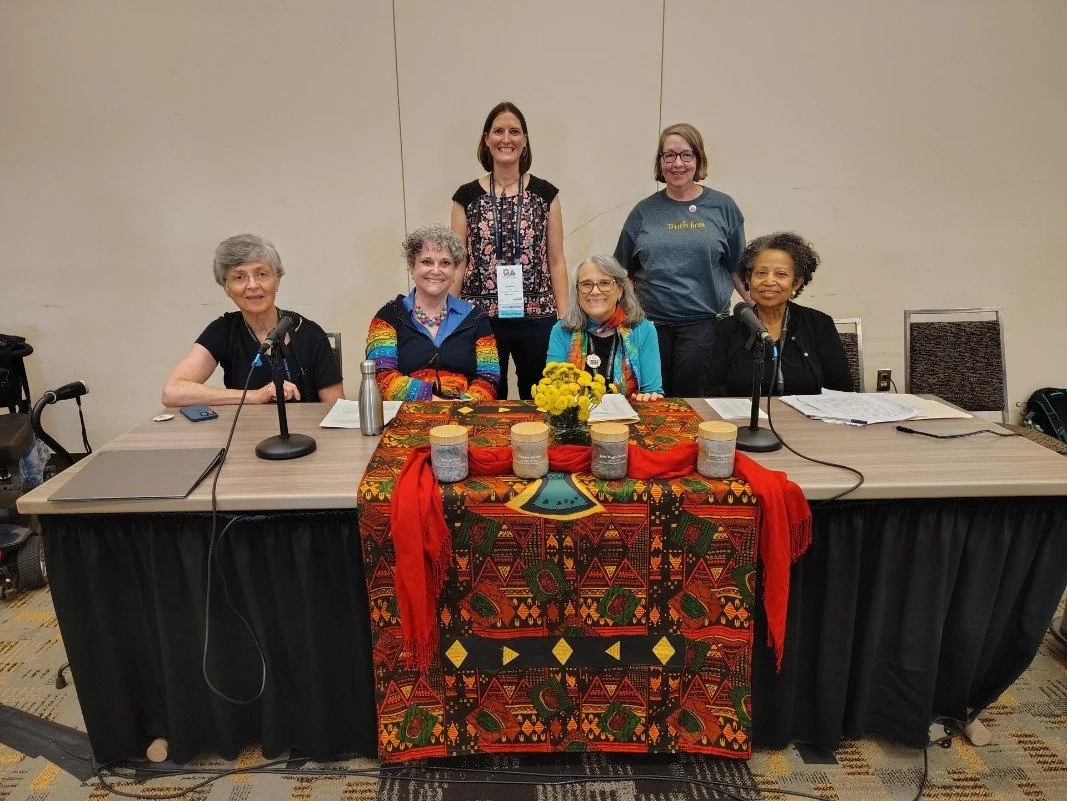
Reflections at an Unitarian Universality Conference ~ Part 2
by Lula Beatty, PhD
Lula Beatty, PhD is a member of the Prince George's County Lynching Memorial Project. Lula also is on the Maryland Lynching Memorial Project board, where she serves as Secretary.
A cohort of MLMP coalition members from Prince George’s, Montgomery, and Baltimore Counties presented the workshop, In Service to Truth: Maryland Lynching Memorial Projects, at the annual convention of the Unitarian Universalist (UU) Association held at the Baltimore Convention Center this past June. They presented the leading-edge efforts in Maryland that bring awareness and justice in response to racial terror lynchings and encouraged attendees, from across the country, to consider undertaking similar racial justice efforts in their communities.
The coalition members also shared the spiritual reasons and grounding that called them to this work and that sustains them. In the Summer 2025 newsletter, three UUA ministers active in local coalitions shared their reasons for engaging in lynching memorial projects. This month, three lay members of UU congregations share their reasons for the work.
Sharon Kniss, a peacebuilding facilitator, reflects: I began volunteering with the Prince George’s County Lynching Memorial Project (PGCLMP) as soon as I heard about it, around 2021. I had studied truth and reconciliation commissions and transitional justice in my undergraduate and graduate education and had been following the work closely since I moved to Maryland in 2020. While I have strong academic interest in the subject and also have a passion for being involved in my local community, for me, being involved in the lynching memorial work and in supporting our county’s hearing for the statewide TRC, has been an important reckoning with my identity as a white woman. The vast majority of racial terror lynchings were conducted on often false and exaggerated premises of the threatened safety of white women. That is a workshop in itself, but as a woman living in a racialized white body, it’s been important for me to acknowledge my identity has been used as an excuse to terrorize others and to refuse to be complicit in its ongoing use. International sites of conscience invite us to say “never again,” and this work in Maryland has been my opportunity to face this truth head-on, be confronted with it on an ongoing basis, and to continue to choose to say both “never again” and “not in my name,” and to work to reclaim my body as a white woman as a tool for racial justice, repair, and truth-seeking.
Lula Beatty, co-secretary of the Prince George’s County Lynching Memorial Project (PGCLMP), shares: In 2018 I had just retired for the second time after completing my passion projects on stress and health disparities and health disparities in vulnerable boys and men, with a heavy focus on Black boys and men. What now? I knew I was going to join a new spiritual home in the county in which I lived, and it would likely be Paint Branch Unitarian Universalist. I also knew that I was going to volunteer for a cause in my county that would spiritually grow me and advance some justice need. A friend from my previous religious home, who was involved in the Montgomery County Lynching Memorial Project, told me about the newly forming Prince George’s County Lynching Memorial Project. She thought it would appeal to me; she was right. I started with PGCLMP in 2019, the first year of its existence. I got to help with its organization, to read the names of victims at the first MLMP annual conference that I attended, to serve as co-secretary, to start our annual racial justice essay and creative arts contest for high school students, and overall to learn more about our common history of violence and injustice and how we all suffer from it. I grew up on a farm in rigidly segregated North Carolina. I was loved and fiercely protected. I heard conversations about racism, but never about lynching. I began to remember whispers of conversations that now had more meaning for me. I remembered Uncle Walker talking about his brother who was intentionally run over by a white man with no legal inquiry or consequences and Uncle Woodall who recounted how a group of white neighbors told him they were going to string him up, then with laughter said they were just joking. Since working with my county’s lynching memorial project, I found out that there was a lynching in the town where I was born and the town where we shopped. My ancestors lived in these communities since slavery times, so they must have known about the lynchings, yet no one ever mentioned a word about them. The intent of racial terror lynchings prevailed. My family, like many others, had been silenced; history had been successfully suppressed. There are still so many truths to be found and spoken and so much reparative body and soul healing to be done. I appreciate being in two places, Paint Branch UU Church and PGCLMP, that provide me with allies and platforms to think, mourn, talk, hope, and do.
Sue Royer, a member of the Baltimore County Lynching Memorial Project, reflects: I started attending programs of the Maryland Lynching Memorial Project in late 2018 or early 2019 after visiting the National Memorial for Peace and Justice in Montgomery, Alabama. There I saw the name Howard Cooper engraved on a steel monument, with Baltimore County also engraved. Justice is a key value of my Unitarian Universalist faith community. How can we achieve justice for all if we don't know about the atrocities that have taken place in the past? How can we change attitudes and build the Beloved Community if we don't know how human beings have been treated?